Funeral Ceremony & AI: The conversation nobody is having.
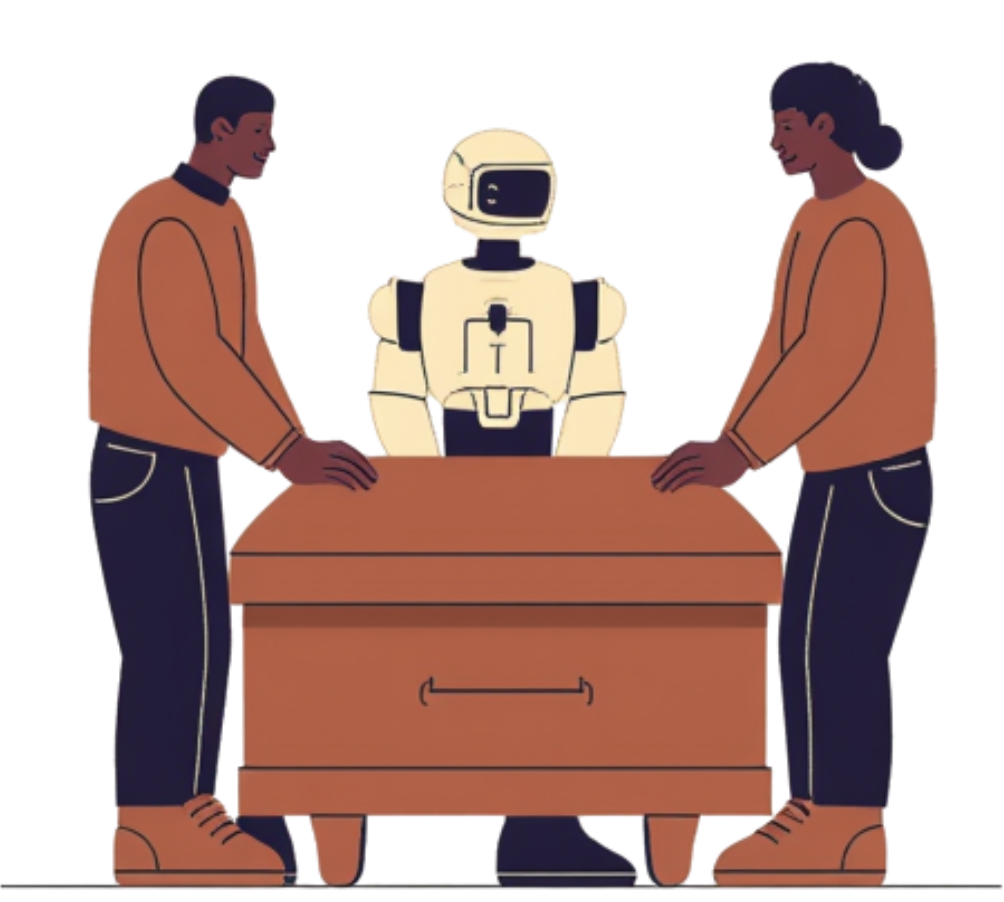
There is a quiet new guest in the room of modern death care.
Not a death doula.
Not a minister.
Not a funeral director.
Artificial intelligence.
It is already helping families write eulogies, craft obituaries and generate personalised tributes and poems. It is already summarising lives. It is already shaping the words spoken over bodies we have loved. And yet, for those of us devoted to doing death differently - returning conscious death care to our homes and communities, cultivating a death care landscape built on tenderness, presence and trust, we are barely talking about what this actually means.
So let’s talk about it.
Not in panic. Not in hype. But in honesty. Because the question is not whether AI will be part of funeral ceremony. It already is. The real question is this: what should remain deeply, fiercely human?
Why this conversation matters
A funeral is not content. It is not performance. It is not a product. It is one of the few remaining public spaces where we collectively acknowledge that love, loss and meaning still matter. In my work as an interfaith minister and funeral director, I see again and again that a funeral is not only about honouring the person who has died. It is about regulating a nervous system. It is about settling a family in shock. It is about holding complexity. It is about making space for unfinished relationships. It is about naming love that may never have found its words in time. So when technology steps into this space, we need to be exquisitely careful. Not because technology is dangerous. But because grief is messy, vulnerable and loaded with complexity.
The case for AI in funeral storytelling
Let’s begin with the genuine and useful possibilities. AI can help families who are overwhelmed. In the days after a death, people often sit frozen in front of a blank page. They know the person. They loved the person. But the words won’t come. AI can help organise timelines and life events, structure a speech when someone has no idea where to begin, edit and refine rough notes, translate stories across languages for multicultural families, and support people who struggle with literacy or confidence in public speaking.
In this way, AI can lower the barrier to participation. It can make storytelling more accessible. It can give people a starting point when their minds are fogged by grief. Used well, it can support families to speak, rather than replacing their voices. And that matters. Because one of the great harms of professionalised death care is that families have slowly been trained to believe they are not capable of doing this themselves. AI, oddly, could return some power back to people by helping them find words they already carry inside them.
The danger no one is naming
But here is the harder truth. AI does not grieve. It does not ache. It does not hesitate. It does not feel the weight of a name catching in the throat. It learns patterns. And grief does not follow patterns. When AI generates a eulogy, it tends to create something that is polished, emotionally familiar, symbolically tidy and safe. But funerals are not tidy.
The real stories that heal families are often awkward. They include contradiction. Humour that feels slightly inappropriate. Anger that still hasn’t softened. Love that arrived late. Distance that never quite closed. AI is trained to resolve. Grief is not. When we let machines overly shape funeral language, we risk sanding down the very edges that make a life feel real. We risk replacing lived memory with emotionally correct storytelling. And emotional correctness is not the same as truth.
What must remain human
Some parts of funeral ceremony simply do not belong to machines, not because machines are evil, but because certain forms of meaning are created only in relationship. A human notices when someone in the room begins to shake, slows down when the energy tightens and senses when silence is doing more work than words. AI cannot read a room filled with grief. It can generate language, but it cannot hold a field. Every family also carries unspoken stories - affairs, estrangements, complex cultural histories, religious wounds and unresolved conflict, and a skilled celebrant or ceremony holder listens for what is not being said. AI has no ethical intuition and cannot feel consequence. When a human helps shape a funeral story, they carry responsibility for the impact of those words. They will meet the family again. They will sit across from people whose hearts are still open. That accountability matters. AI does not live inside community.
Where AI can ethically assist
There is, perhaps, a beautiful middle ground. AI can become a companion tool, not an author. There are places where ethical, supportive use can genuinely help, such as organising memories shared by many people into a clear structure, helping someone turn spoken memories into written form, supporting families to draft first versions they then deeply edit, helping culturally and linguistically diverse families bridge language barriers, and assisting people who want to speak but fear getting it “wrong”. In this model, AI becomes scaffolding. Not the building. The story still belongs to the people who lived it.
The deeper question beneath the debate
The real issue is not about technology. It is about authorship. Who gets to tell the story of a life? For decades, families have slowly outsourced grief to professionals. Funeral directors. Ministers. Systems. Templates. AI is simply the next layer of outsourcing. If we are not careful, we risk creating funerals that are beautifully written but emotionally hollow. Ceremonies that sound right, but do not feel true. The deeper work I am committed to in my practice is not perfect language. It is restoring people’s confidence to speak from their own hearts. To be clumsy. To be unsure. To be real.
A quiet ethical line
Here is a line I hold clearly: AI may help you find your words. It should never replace your voice. If a eulogy could be spoken at any funeral, for any person, without anyone noticing the difference, something precious has been lost. Your loved one was not generic. Their life does not deserve generic language.
The future of funeral ceremony
AI will continue to evolve. Families will use it more and more. Funeral providers will quietly integrate it into workflows. This is inevitable. But we still get to choose how we hold the soul of ceremony. We can build a future where technology supports storytelling without owning it. Where machines help us organise memory but never define meaning. Where human presence remains central. Where grief is allowed to be messy, slow and unresolved.
Funeral ceremony is not simply about telling a story. It is about shaping a moment in which a community collectively acknowledges that a life mattered.
No machine can feel the weight of that responsibility.
And I hope we never ask it to.