A plain-language guide to funeral costs in Australia
If you’d prefer a version to save or print - you’re welcome to download the PDF version here.
Funerals can be expensive. That much most people know. But when a bill arrives in the days after someone has died, it can feel impossible to understand what you're actually paying for, or whether any of it was necessary.
This guide is for families who want to understand. Not to fight the invoice or find someone to blame, but to make sense of what goes into a funeral so that next time - whether that's for someone else or for your own planning - you can ask better questions and make clearer choices.
Some of this will surprise you. Some of it will reassure you. All of it is worth knowing.
The Costs Behind Every Funeral
Transfer of the Person
From $350+
This is the first thing that happens after a death - moving your person from the place they died to the funeral home. It sounds straightforward. It isn't. Transfers often require a minimum of two trained staff available at short notice, often at unusual hours. It requires specialist equipment and a refrigerated vehicle, and careful handling in line with both legal requirements and basic human dignity.
If your person died in hospital, in a nursing home, at home or in a regional area, the logistics shift. Distance, access and timing all affect the cost.
Mortuary Storage & Care
From $460+
Once in the care of the funeral home, your person is held in a temperature-controlled environment until the funeral takes place. This is not simply cold storage - it is a carefully managed space that ensures the body is preserved safely and with respect for the family's wishes around viewing and gathering. Storage costs can increase with time, which is worth factoring in if you are waiting for family to travel or for a ceremony date to align.
The people who care for the dead are highly trained. Whether a full embalming is requested or a gentler preparation - closing the eyes and mouth, dressing your person, shaving, hair and makeup - this work is skilled, and it matters enormously to the families who choose to spend time with their person before the funeral.
NB: Embalming is not legally required in Australia. It is most often recommended when a viewing is planned, the body needs to travel interstate, or there is a longer period between death and the funeral. A good funeral director will explain when it is and isn't necessary, rather than offering it as a default.
The Funeral Arranger
From $1400+
Arranging a funeral involves a significant amount of invisible work. Your arranger is coordinating the transfer, the mortuary care, the venue, the celebrant, the coffin, the death certificates, the cremation or burial booking, the death notices, the printing - often across multiple providers and government departments, all under time pressure and while supporting a family in grief.
This role takes experience, emotional intelligence and meticulous attention to detail. When it's done well, it feels effortless. That effortlessness is the work.
The Coffin
Cardboard from $220+
MDF from $550+
Wicker from $980+
Solid timber from $1500+
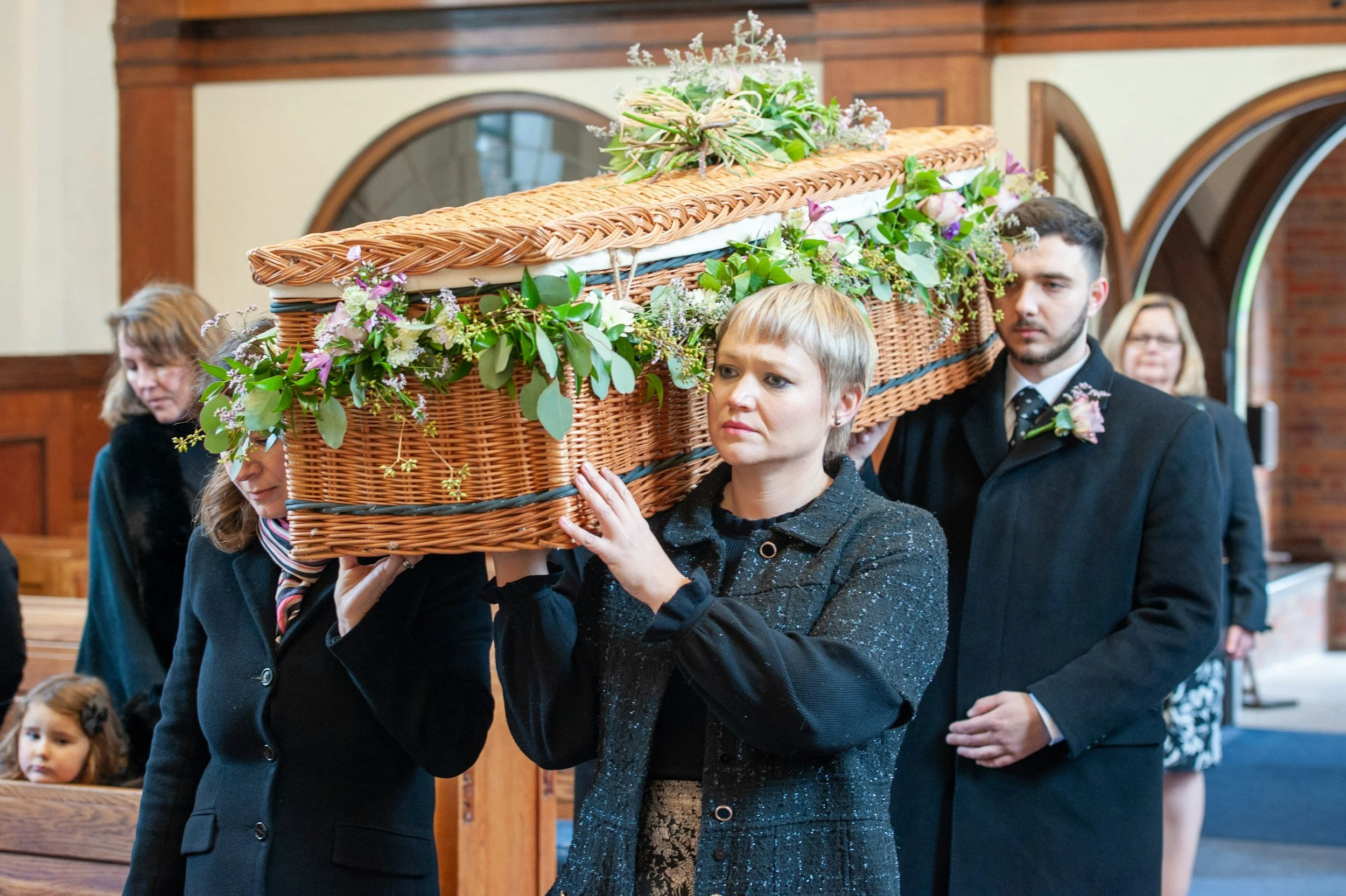
Coffins vary widely in price depending on material, supplier and origin. Families are increasingly asking about alternatives - wicker, cardboard, simple pine, shrouded cremation - and a good funeral home will be able to accommodate those choices. You are allowed to ask what the options are.
The coffin also needs to be transported from the supplier to the funeral home and then to the place of committal. That transfer is often part of the overall coffin cost.
The Hearse and Vehicles
From $770+ (per 4 hours)
The hearse is more than a vehicle - it is a public marking of the passage of a life. Families who choose to use a hearse are often surprised by how much it shapes the experience of the day. The slow drive, the procession, the visibility of it. And they don't have to be traditional black. I often work with local suppliers who have beautiful vintage Mercedes hearses in light blue, white and grey. The hearse can reflect something of who your person was, which is always worth asking about.
Limousines and additional family vehicles - sometimes called mourning cars - are a separate cost. Most families choose to use their own cars. That is always an option and there is nothing lesser about it.
The Venue
From $550+ - $2k+
Venues range from chapels at funeral homes, to churches, to community halls, to parks, beaches and private homes. Each carries different costs and logistics. A council park with no hire fee still requires planning and equipment. A funeral home chapel can be convenient but is not the only option.
The venue shapes the ceremony more than most families realise. Where people gather - and how - affects what's possible in terms of music, movement, participation and feeling. It's worth asking about options before defaulting to the most familiar choice.
The Celebrant
Starting from $980+
This is where I want to pause, because it matters.
The celebrant is the human heart of a funeral. A skilled, experienced celebrant can hold a room of grieving people, tell the truth of a life, create space for laughter and tears in the same breath, and give a family something they carry with them for the rest of their lives. A poor fit can leave a ceremony feeling hollow and forgettable.
The fee structure most traditional funeral directors use for celebrants was inherited from the days when most ceremonies were conducted by clergy who were already supported by a church stipend and the accumulated donations of a congregation. Civil and secular celebrants have never had that support structure. They are independent practitioners who cover their own costs, invest in ongoing training and depend on ceremony fees as their primary income. The industry has been slow to reflect that reality in what it pays. A good celebrant is always worth the investment - ask about their experience, read their testimonials, and understand what you're paying for.
Investing well here is one of the clearest ways to shape the quality of your experience on the day.
Staff on the Day
From $165+ per staff member
A funeral requires people. More than most families realise.
For a cremation service, a minimum of two to three staff are typically present - to receive the family, manage the logistics of the day and carry the coffin with care. For a burial, the minimum is four. Pallbearing alone requires that number, and that's before accounting for the staff member coordinating the family, managing the graveside, assisting with religious rituals/customs and ensuring everything runs with the dignity the moment deserves.
These are not people standing around. They are trained professionals holding the practical and emotional weight of the day so that the family doesn't have to.
Flowers
From $250+
Flowers are entirely optional and entirely personal. From a single native arrangement to an elaborate floral installation, the range is wide. Many families choose to redirect flower costs into a donation, a memorial tree or a piece of music that meant something to their person.
There is no right answer. There is only what feels true.
Body Disposition: Cremation or Burial
Cremation from $565+ | Burial from $1650 + plot fees | Government Levy from $45+
The actual process of cremation or burial carries its own costs, and these vary significantly depending on the option you choose.
Cremation fees include the crematorium facility, staff and - in most states - a government levy. Burial costs include the grave plot, opening and closing the grave, and any additional cemetery fees. Both have associated paperwork.
Increasingly, families are asking about alternatives to traditional cremation and burial. These include:
Aquamation (alkaline hydrolysis) - a water-based process that is gentler on the body and significantly lower in carbon emissions than flame cremation (Approx $5k - $6k)
Natural burial - where the body is interred without embalming in a biodegradable coffin or shroud, returning to the earth directly
Body donation to medical science - a meaningful choice for some families, and one that often covers the cost of a simple cremation at the conclusion of the donation period
Terramation (human composting) - not yet legal in Australia, though advocacy to change that is underway
Asking your funeral director about these options is always appropriate. You deserve a full picture.
Medical Certificates and Paperwork
From $400+ e.g. Death Certificate = $68 / Cremation Certificates = $330
A death cannot be registered without the correct medical and legal paperwork. Depending on the circumstances of the death, this may involve a medical certificate from the treating doctor, a coroner's involvement, or additional administrative processes. Your funeral arranger manages this on your behalf, and the associated fees are part of the overall cost.
The Operating Costs of the Funeral Home
Service Fee approx 15-40% of arrangement, or built into line item pricing
This is rarely discussed openly, and it's worth understanding.
Funeral Directors carry significant fixed costs. Staff available around the clock. Premises appropriate for receiving the dead and welcoming grieving families. Vehicles maintained to a high standard. Specialist equipment. Compliance with health and safety regulations. Insurance. These costs exist regardless of how many funerals take place in a given week.
Different funeral homes reflect those costs in different ways.
Some build them invisibly into each line item - the transfer fee, the storage, the arrangement - so there's no separate service charge on the invoice. The costs are still there. They're just distributed across the quote.
Others offer closer-to-wholesale pricing on individual items and add a transparent service fee that sits alongside them. This approach makes the operational cost of running a funeral home visible rather than hidden, which some families find easier to understand and compare.
Neither model is inherently better or worse. What matters is that you're looking at the full picture - not just comparing a single line item between two providers - and that your funeral director can explain how their pricing works when you ask.
A good funeral home will always be able to walk you through their quote clearly. If they can't, that tells you something too.
Optional Extras
Not every funeral includes all of these, and none of them are compulsory. But they appear on many invoices and it's worth knowing what they are. All of these are choices. A good funeral director will present them as options rather than assumptions…
Cooling plate or cooling bed hire: If your family wants to have your person at home before the funeral, a cooling plate or cooling bed can be hired to keep the body at a safe temperature. This is a practical and often beautiful choice that more families are making, and your funeral director can advise on how it works.
Approx. $275 set up + $165/night
Viewing and chapel hire: Spending time with your person before the funeral is one of the most meaningful things a family can do. Most funeral homes offer a dedicated viewing space and staff to welcome and support you during that time. This is booked separately and worth asking about early, particularly if multiple family members want to visit at different times.
From $250+
Order of service booklets: A printed order of service gives people something to hold on the day and something to take home. Funeral homes can arrange these, or families can design and print their own. Either is entirely appropriate.
From $200+
Slideshow tribute: A photo slideshow shown during the ceremony can say more about a life than words alone. This can be produced by the funeral home or put together by the family - a laptop and a decent playlist are often all that's needed.
From $220+
Live streaming: For families where loved ones can't travel, live streaming means nobody has to miss the farewell. Most funeral homes now offer this, and the quality has improved considerably. It's worth asking what the recording options are, so the stream can be revisited afterward. There’s also dedicated film crews who specialise in live streaming funerals beyond the standard venues - an incredible keepsake and the ability to ensure families far & wide can feel a part of the ceremony.
From $1210+
Catering: A gathering after the funeral - with food, with tea, with time to talk - is often where the real sharing happens. Some funeral homes offer catering or venue hire for this. Many families prefer to organise it themselves, at home or at a local venue, which is usually more personal and less expensive.
Prices often vary based on a per-head and families often liase directly with caterers
Newspaper death notices: A death notice in a local or national paper is a way of letting a wider community know. The fee is charged by the publication and varies depending on length and placement. Many families now use social media instead, or alongside, which carries no cost.
From $175+
Urns: If your person is being cremated, the cremains will be returned in a basic container as standard. An urn is an optional upgrade and the range is wide - from simple and understated to beautifully handcrafted. Families can also purchase urns independently, which is entirely permitted and often more personal. If you plan to scatter the cremains, you may not need an urn at all.
From $66 - $1000+
What You Can Do With This
Understanding the breakdown of a funeral invoice is not about finding ways to cut corners. It's about being an informed participant in one of the most significant events of your life.
You can ask questions. You can request a full itemised quote. You can compare providers. You can make choices that align with your values - about sustainability, about cost, about what ceremony means to your family.
And you can do this before you are in crisis. Pre-planning a funeral, or simply having a conversation with someone you trust about what you would want, is one of the kindest things you can do for the people who will care for you when the time comes.
If you'd like to talk through your options - whether you're planning ahead or navigating a loss right now - I'm here to help. x
The costs described in this guide are general estimates based on Sydney metropolitan pricing in 2026. They are intended to give families a broad understanding of what is involved in a funeral and should not be taken as a quote. Prices vary between providers, regions and individual circumstances. Always request a full itemised quote from your funeral director before making any decisions.
Here’s some more guides to help you through the tender moments…


As a funeral director, I’ve come to understand that there are moments in grief that catch us off guard. One of those moments is when I knock on your door holding the ashes of your loved one. This quiet exchange is often more emotional than people expect. This gentle guide offers 3 simple ways to allow this moment to feel supported.