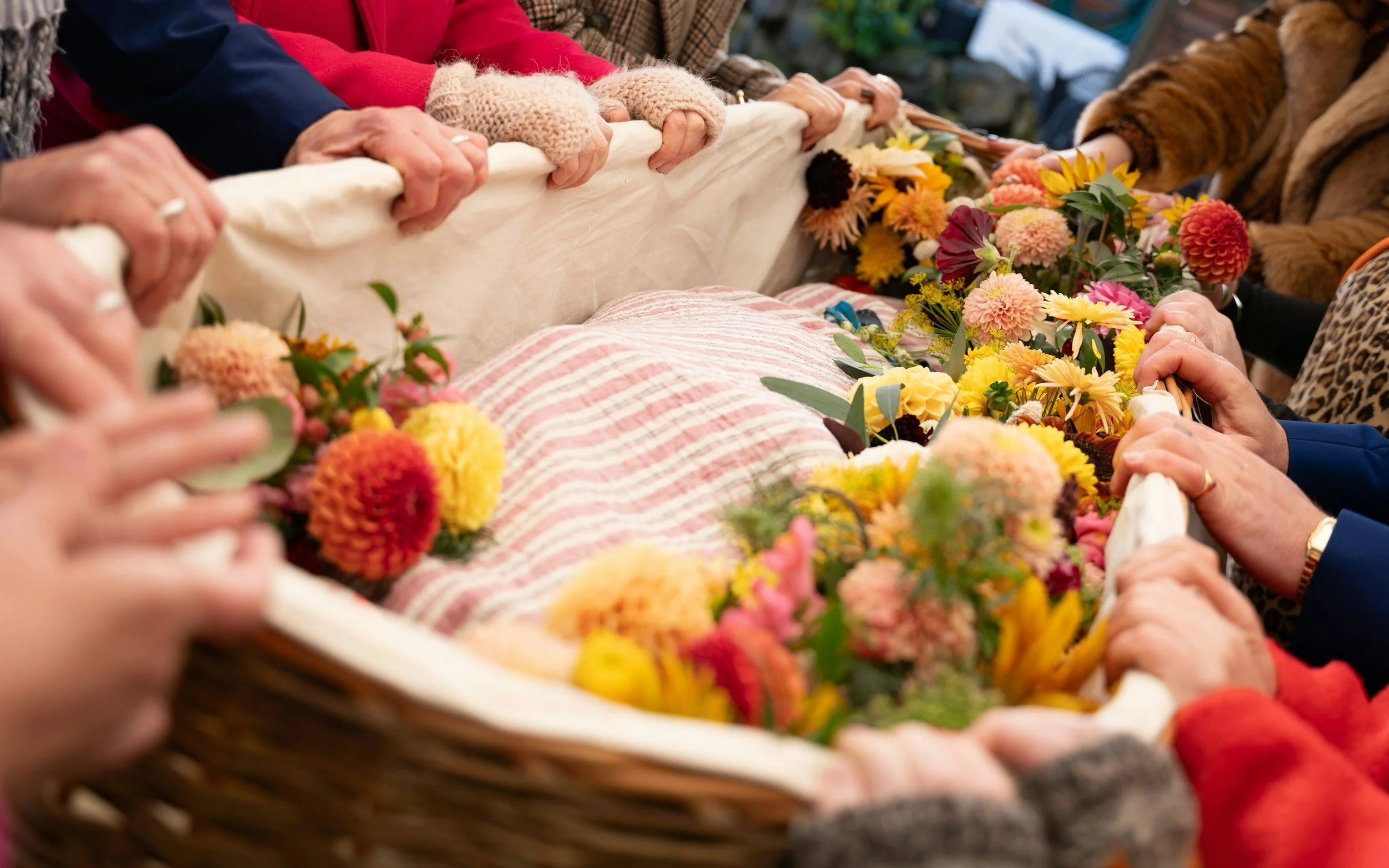
Grief isn’t something most of us experience well by sitting quietly in rows. For some families, that’s exactly what’s needed. The structure and familiarity of a traditional funeral can be deeply comforting.
But for others, the most meaningful ceremonies invite people to do more than simply watch. When people carry the coffin, light a candle, scatter ashes, share a story, plant a bulb, write a note or place a flower on the coffin, the ceremony stops being something that happens to them. It becomes something they create together. That shift matters.
People leave not only having witnessed a farewell, but knowing they helped shape it. They become participants instead of an audience.
Participation doesn’t have to be elaborate. The smallest invitations are often the most powerful. Holding a photograph as it’s passed around the room. Sharing a single word that describes the person. Writing a message on the coffin. Taking home a cutting from their garden or a favourite recipe.
Our bodies process grief as much as our minds do. Sometimes we need something to do, not just something to listen to. Lighting a candle. Walking together. Singing. Cooking. Surfing. Planting a tree. These simple acts help us move through grief in ways words alone often can’t.
And when we do those things together, something shifts.
Grief becomes a little less lonely.
This, I think, is what ceremony has always been for. Not an audience watching from the sidelines, but a community carrying one another through one of life’s hardest moments.
Many of the ideas below came from families in our community who shared what they did. Take what fits. Leave what doesn’t. There are no ceremony police.
Bring them into the room
1. Wear them
Skip the black dress code and invite everyone to wear something the person would have loved: leopard print, Hawaiian shirts, footy colours, glitter, floral dresses, odd socks, denim jackets or their favourite band T-shirt.
2. Fill the room with their everyday things
Fishing rods. Their watch. Their favourite hat. Their bike helmet. Their beloved Scrabble board. Their favourite bottle of booze. Cookbooks. Their reading glasses. The things they reached for every day often tell their story better than photographs.
3. Let people smell them
Their favourite perfume. Fresh bread baking. Lavender from the garden. Coffee brewing. Eucalyptus. Engine oil. WD-40. Scent can bring someone back into the room like nothing else.
4. Play their music
Not funeral music. Their music. The song they always turned up too loud. The one everyone rolled their eyes at. The one that makes people smile because it couldn’t belong to anyone else.
5. Use their handwriting
A recipe card. A shopping list. A note from the fridge. A birthday card. Print it in the order of service or display it around the room. Handwriting can make someone feel unexpectedly close.
6. Take your shoes off
One man spent most of his life barefoot, so his family invited everyone to come without shoes. Think about what was unmistakably theirs and ask people to join in.
7. Show what their hands made
Quilts, paintings, woodwork, jumpers, pottery, the shed full of half-finished projects. Let people see the person in the things they made.
8. Invite the pets
If it feels right, let the dog come. Or the horse. Or the chooks wandering through the backyard. Animals don’t care much for ceremony, and somehow they often remind us how to be present.
Invite people to add something
9. Write on the coffin
Hand around markers and invite messages, drawings and terrible in-jokes. A plain or cardboard coffin becomes a guestbook they take with them.
10. Lick a stamp
For a stamp collector, guests each stuck a stamp onto the cardboard coffin until it was covered. Think about what their version of a stamp might be.
11. Tie something on
Ribbons on a branch. Notes on a string. Fabric scraps in their favourite colours.
12. Place the last piece
A woman who loved jigsaws was farewelled with everyone placing a puzzle piece in her coffin. This also works well with Scrabble, Chess, Checkers - any sort of board game.
13. One for them, one to pass on
A man who played guitar with his mates was given a guitar pick from each of his daughters in his pocket. Years later, as each of his friends died, the family placed two picks in their pocket: one for them and one to give to him.
14. Fill a jar with memories
Each guest is given a small stone, then comes forward to drop it into a large vase while remembering something about the person. Afterwards, the jar of “happy thoughts” goes home with the family, who can run their fingers through it.
15. Bring their work to the graveside
For a man from a farming family who worked in agriculture, people dropped stalks of wheat onto the coffin as it was lowered. A gardener might get rose petals, a fisher a few shells, a builder a handful of sawdust.
16. Give them their favourite treat
One mum was a serious chocoholic, so everyone took a chocolate from a big tub and placed it with her on the way out of the chapel.
Share something in the moment
17. Pass around what they always carried
Their favourite mints. A deck of cards. Sunflower seeds. Their famous biscuits. The little things people came to associate with them.
18. Have the tea party, bake the recipe
Days before she died, one woman said she’d love a tea party. At her memorial, everyone drank her favourite specialty teas together. Another family baked a batch of a grandmother’s famous oat biscuits, then bagged each one with a recipe card and her photo for everyone to take home. If someone asked for something, consider giving it to them anyway.
19. One word each
Invite everyone to say, write or think a single word that describes the person. It’s simple, it’s quick and it’s often surprisingly moving.
Give away the things they loved
20. Let their library find new homes
A keen cook left a big collection of cookbooks. Her family put a name plate inside each cover and invited guests to take one. The same works for novels, gardening books or a reader’s whole bookshelf.
21. Share what they made, mended or collected
A retired watchmaker had spent years restoring old alarm clocks. At his funeral, two tables were covered in them and everyone was invited to take one home. The same idea works for Christmas decorations, jewellery, tote bags, records, scarves, stubby holders, jigsaw puzzles or mugs. People love showing each other what they picked, and it lets a life keep travelling.
22. A cup of tea, from their cupboard
A woman with a collection of antique teacups had them handed out to family, each with a teabag and a note: think of me when you have a cuppa.
Something to carry forward
23. Make funeral badges
Think of a saying, slogan, favourite expression or piece of wisdom that captures something about the person. Have it printed on badges for everyone to wear and take home. It might be something they always said, a phrase that made everyone laugh or a reminder of how they lived. A little piece of their language that people can carry forward into the world.
24. Send something growing home
Forget-me-nots, sunflowers or something from their own garden. One family made birdseed packets for a mum who loved watching birds, with a note inviting people to keep feeding them. Another shared cuttings of rosemary, succulents and geraniums. A bit of their garden keeps growing in everyone else’s.
25. Travelling stones
A woman who loved travel was remembered with smooth stones with her name on them. People take them on holidays and photograph them in new places, then share the pictures via a QR code. Her nieces made them together over a few glasses of wine, which was a ritual in itself.
26. Swap a memory
Everyone writes a word on a flat stone and places it in a basket. As people leave, they take someone else’s stone, so they go home carrying another person’s memory of them. The family can keep some too.
Give in their name
27. Bring a tin instead of flowers
One family asked guests to bring tins of food for a local pantry supporting the homeless. It took a whole crew of grandkids two trips to carry the donations up the aisle, and the pantry was stocked for months.
28. Give to what they cared about
A schoolteacher’s family asked for school supplies. Another family set up a donation basket that funded holiday meals for kids who usually rely on school lunches. Ask what they’d want their goodbye to make possible.
Final thought...
Have a chat with your funeral director about what can go in or on the coffin, especially if there’s a cremation or a natural burial. Some things are fine, and some need to stay out or come home with the family. A good funeral director will help you find a way to make it happen.
